
Electric bicycles have become an increasingly visible part of everyday transportation in the United States. Teenagers use them to travel to school, meet friends, visit parks, attend sports practices, and explore their neighborhoods without depending on parents for every trip. For many families, an e-bike offers a convenient combination of independence, recreation, and physical activity.
However, teen e-bike safety deserves special attention because electric bicycles can travel faster than young riders expect, accelerate quickly, and require sound judgment in traffic. A teenager who is comfortable riding a conventional bicycle may not immediately understand how electric assistance changes braking distances, cornering, speed control, and the time available to react to a hazard.
Parents do not need to prohibit every e-bike ride to reduce these risks. Instead, they can help teenagers develop practical riding skills, choose appropriate equipment, understand local laws, recognize dangerous situations, and make responsible decisions when friends or traffic create pressure to take risks.
The goal is to establish safe habits before a teenager begins riding independently. A helmet, properly maintained bicycle, and knowledge of traffic rules all matter, but so do maturity, experience, communication, and consistent family expectations.
This guide explains how parents can prevent common e-bike crashes, recognize risky behavior, select safer equipment, establish riding rules, and help teenagers become responsible road users.
Why Teen E-Bike Safety Matters
An electric bicycle combines the familiar structure of a bicycle with an electric motor that assists the rider. Depending on the model, the motor may provide assistance while pedaling, propel the bicycle through a throttle, or offer both functions. These differences affect how the bicycle responds when a rider accelerates, slows down, or navigates a crowded area.
For teenagers, the attraction is understandable. E-bikes can make hills easier, shorten travel times, and allow friends with different fitness levels to ride together. They may also offer a useful alternative to short car trips.
Yet the same convenience can create a false sense of security. A teenager may assume that riding an e-bike is no more complicated than riding a regular bicycle, even when the electric model is heavier, faster, or more powerful.
The U.S. Consumer Product Safety Commission (CPSC) advises riders to wear helmets, follow local traffic laws, inspect their equipment, and use micromobility products that meet applicable safety standards. Its Micromobility Safety Information Center provides guidance on safe operation, visibility, maintenance, and battery charging.
These recommendations are especially relevant to families because an e-bike crash can involve more than the rider. A teenager may collide with a pedestrian, another cyclist, a parked vehicle, or a car turning across a bike lane. Safe riding therefore requires awareness of other road users, not simply control of the bicycle.
How Electric Assistance Changes Riding
Electric assistance can make a bicycle accelerate with less physical effort. A rider who starts pedaling unexpectedly or applies a throttle without understanding its response may move forward faster than anticipated.
The bicycle’s additional weight can also affect handling. A heavier e-bike may require more effort to maneuver, lift, or stop, particularly for a smaller teenager. Braking technique becomes important because grabbing the brakes suddenly while turning or traveling on loose gravel can destabilize the bicycle.
Parents should arrange practice sessions in a controlled area before allowing independent rides. Teenagers should learn how their particular model accelerates, how much pressure the brakes require, and how the bicycle behaves on slopes and uneven surfaces.
Why Experience on a Regular Bicycle Is Not Enough
A teenager who has ridden a bicycle for years may understand basic steering and balance but still lack experience with powered acceleration, heavier frames, and faster approaches to intersections.
For example, a rider may normally approach a stop sign at a manageable speed on a traditional bicycle. On an e-bike, the same rider may arrive sooner than expected and need more distance to slow down comfortably.
Parents should treat the first weeks of e-bike ownership as a training period. Familiarity with ordinary cycling is an advantage, but it should not replace instruction and supervised practice on the actual electric bicycle.
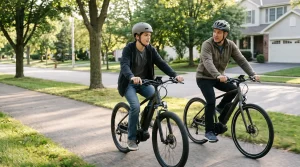 Choose an E-Bike That Matches Your Teenager’s Age and Abilities
One of the most important decisions parents make is choosing an appropriate electric bicycle. Marketing claims, attractive designs, long battery ranges, and high advertised speeds can distract from the question that matters most: Is this model suitable for this particular teenager and the places where they will ride?
Understand E-Bike Classifications
In many U.S. jurisdictions, conventional e-bike classifications distinguish between three common types.
Class 1 e-bikes provide motor assistance while pedaling and stop providing assistance at 20 mph. Class 2 e-bikes can provide motor assistance through a throttle and generally have a motor-assisted maximum speed of 20 mph. Class 3 e-bikes provide pedal assistance up to 28 mph and generally include a speedometer.
These classifications are widely used, but state and local definitions, age restrictions, helmet rules, and permitted riding locations differ. A bicycle’s classification does not automatically determine whether a teenager may legally ride it on a particular street, path, or trail.
Before purchasing an e-bike, check the applicable state and municipal requirements. Pay particular attention to minimum rider ages, restrictions on Class 3 models, mandatory helmets, and whether throttle-equipped bicycles are permitted on local trails.
Parents should also examine the manufacturer’s specifications. A product advertised as an electric bicycle may exceed the power or speed limits associated with the legal e-bike category in their jurisdiction. A model marketed for off-road use may not be legal on public roads or shared-use paths.
Prioritize Control Over Maximum Speed
A high top speed is rarely the most important feature for a teenager’s everyday transportation. Reliable brakes, predictable acceleration, suitable frame dimensions, stable handling, quality tires, and adequate lighting deserve greater attention.
A suitable e-bike should allow the teenager to place their feet securely on the ground when appropriate, reach the handlebars comfortably, operate the brakes confidently, and control the bicycle without excessive effort. The rider should be able to maneuver at low speeds and make controlled stops without feeling overwhelmed by the bicycle’s weight.
Parents should consider a model with a manageable assistance setting and a predictable power response. If the bicycle allows adjustable assistance, begin with the lowest practical setting while the teenager develops confidence and control.
Avoid modifying the motor or controller to increase speed. Such changes can affect handling, braking demands, battery safety, warranty coverage, and legal classification. A modification that makes a bicycle faster can turn a manageable learning experience into a substantially more demanding riding situation.
Check the Bicycle Before Buying
Inspect the frame, tires, brakes, wheels, lights, battery, and charging equipment. Ask the seller about product testing and relevant safety certifications. For the electrical system, look for appropriate certification to a recognized standard, such as UL 2849, where applicable.
Certification is not a substitute for maintenance, but it is a useful factor when evaluating an e-bike’s electrical safety. Families should also review manufacturer instructions, warranty terms, and available service support.
Buying a bicycle from a reputable seller who can explain its specifications and arrange repairs is often preferable to choosing an unfamiliar model solely because it offers a higher advertised speed at a lower price.
Make Helmet Use a Nonnegotiable Family Rule
A properly fitted bicycle helmet is one of the most important pieces of protective equipment for a teenager. Helmets help reduce the risk and severity of certain head injuries, although they cannot prevent every concussion or protect every part of the body.
Parents should establish a simple expectation: no helmet, no ride. This rule should apply to short neighborhood trips, rides to a friend’s house, trips to school, and recreational rides.
Teenagers sometimes resist helmets because of appearance, hairstyle concerns, or peer pressure. Parents can address these objections by involving their child in choosing a comfortable helmet that meets applicable safety standards rather than treating helmet selection as an afterthought.
How to Fit a Teen E-Bike Helmet
A helmet should sit level on the head and cover the upper forehead. It should not tilt far backward or slide forward over the eyes. The side straps should form a secure V-shape around the ears, and the chin strap should be snug enough to prevent the helmet from moving excessively without causing discomfort.
Have the teenager shake their head gently after fastening the straps. If the helmet shifts significantly, adjust the fit or choose a different size or model.
Parents should check the fit periodically, especially during growth spurts. A helmet that fitted properly last year may now be too small. Similarly, a helmet borrowed from a sibling may not fit correctly even if it looks suitable.
Choose a helmet designed for cycling and appropriate for the intended riding conditions. Follow its manufacturer’s guidance regarding replacement after an impact, visible damage, or other circumstances that could compromise protection.
For additional practical guidance on bicycle helmets and safe riding, parents can consult the National Highway Traffic Safety Administration’s bicycle safety resources.
Make Protective Gear Part of the Routine
Helmets should be accompanied by other practical precautions. Closed-toe shoes, secure clothing, and gloves may improve comfort and reduce some injuries in a fall. Eye protection can help keep dust, insects, and debris out of a rider’s eyes.
Knee and elbow protection may be appropriate for beginners or riders practicing skills in controlled environments. However, protective pads do not make speeding, weaving through traffic, or performing stunts safe.
Parents should model the same behavior they expect. If adults wear helmets and check their equipment before riding, teenagers are more likely to see these actions as normal rather than as rules imposed only on children.
Teach Traffic Rules Before Independent Riding
Knowing how to operate an e-bike is only part of being a safe rider. Teenagers must also learn how to behave around motor vehicles, pedestrians, parked cars, traffic signals, and other cyclists.
Parents should review the rules that apply in their state and community, then practice those rules on familiar streets. Do not assume that a teenager understands traffic signs simply because they have traveled as a passenger in a car for years.
Follow Traffic Signals and Stop Signs
Teenagers should come to a complete stop where required, obey traffic signals, yield appropriately, and check for approaching traffic before proceeding. They should never assume that a vehicle will stop simply because they have the right of way.
Teach your teenager to approach intersections at a controlled speed. They should scan for vehicles approaching from different directions, watch for drivers turning across their path, and look for pedestrians entering the roadway.
A useful practice exercise is to ride together through several familiar intersections and discuss potential hazards before reaching them. Ask your teenager what they would do if a car approached from a side street or if a vehicle ahead suddenly began turning.
The objective is to develop anticipation rather than last-second reactions. A rider who recognizes a developing hazard early has more time to slow down, stop, or choose a safer position.
Ride Predictably and in the Correct Direction
In general, cyclists should travel in the same direction as motor vehicle traffic when using the roadway, subject to applicable local rules. Riding against traffic can make it harder for drivers to judge a cyclist’s movement and can increase the risk of conflicts at intersections.
Teenagers should avoid weaving between parked cars, moving unpredictably between the road and sidewalk, or making sudden turns without checking their surroundings.
When turning, riders should look behind them when safe, signal their intention where appropriate, and move into a suitable position before making the turn. They should maintain control of the handlebars and avoid taking unnecessary risks simply to reach a destination more quickly.
Parents should explain that riding predictably is not the same as assuming every driver will behave correctly. Even when a teenager follows the rules, a driver may be distracted or fail to notice the bicycle. Defensive riding means leaving enough time and space to respond.
Understand Bike Lanes and Shared-Use Paths
Bike lanes can help separate cyclists from motor vehicles, but they are not completely free of hazards. Cars may enter a lane to turn, delivery vehicles may stop in it, and parked vehicles may open doors into a cyclist’s path.
Teach teenagers to scan ahead rather than focusing only on the pavement immediately in front of the wheel. If a lane is obstructed, they should slow down, check surrounding traffic, signal where appropriate, and move around the obstruction only when it is safe and legal.
Shared-use paths present different challenges. Pedestrians, children, dogs, joggers, and slower cyclists may all use the same space. Teenagers should reduce speed in crowded areas, give an appropriate warning before passing when safe, and leave enough room for other users.
Parents should verify which e-bike classes are permitted on local paths. A route that is legal for a conventional bicycle may have restrictions for certain electric models.
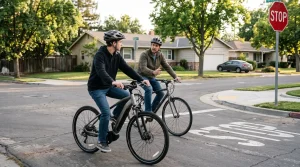 Teach Teenagers to Recognize Common E-Bike Crash Risks
Many preventable crashes begin with a familiar mistake: traveling too quickly for conditions, overlooking a vehicle, braking abruptly, or assuming another road user will move out of the way.
Parents can make safety instruction more effective by discussing realistic situations rather than simply telling teenagers to be careful.
Intersection Collisions
Intersections require riders to process multiple sources of information at once. A teenager may need to monitor a traffic signal, a vehicle approaching from behind, pedestrians crossing, and a car preparing to turn.
One common danger occurs when a vehicle turns across a cyclist’s path. A driver may look for larger vehicles and fail to notice a relatively narrow bicycle approaching in a bike lane or along the side of the road.
Teach teenagers to reduce speed as they approach intersections, position themselves where they are visible when practical, and watch the front wheels and movement of nearby vehicles for signs that a turn may begin.
They should never race through an intersection to beat a changing signal. If they cannot cross safely within the permitted signal phase, stopping and waiting is the better decision.
Driveways and Parking Lots
Driveways, parking lot entrances, and garage exits are common conflict points because drivers may have limited visibility when backing out. A teenager traveling quickly along a sidewalk or path may enter a driver’s field of view with little warning.
Encourage teenagers to slow down near driveways, watch for reversing lights, and avoid assuming that a vehicle will remain stationary. In parking lots, they should expect cars to move in several directions and pedestrians to step between parked vehicles.
Parents can practice these skills in a quiet parking area by identifying possible blind spots and discussing how to approach them cautiously. The aim is to make scanning and slowing down automatic habits.
Car Doors Opening Into the Rider’s Path
A parked vehicle can conceal a person preparing to exit. If a teenager rides too close to a line of parked cars, an opening door may block the bicycle’s path suddenly.
Teach your child to maintain a safe distance from parked vehicles whenever road conditions and applicable rules allow. They should also scan for signs that someone may be preparing to leave a vehicle, such as illuminated interior lights or visible movement.
If a roadway is too narrow to maintain adequate clearance, slowing down and assessing whether a safe alternative exists is better than squeezing through a gap.
Wet Roads, Gravel, and Uneven Surfaces
Electric bicycles can lose traction on wet pavement, loose gravel, leaves, painted road markings, and metal covers. Potholes and broken pavement can also destabilize a bicycle, especially when the rider approaches them at high speed.
Teenagers should reduce speed in poor conditions, avoid sharp steering movements on slippery surfaces, and use smooth braking inputs. They should not attempt sudden turns or hard braking without considering the available traction.
After rain, oil and debris may remain on the road. Reduced visibility and standing water can also hide potholes. A familiar route may therefore require a different riding speed depending on the weather.
Parents should explain that good riding means adjusting to conditions rather than maintaining the same speed everywhere.
Mechanical Failures
A crash can occur because a component is loose, worn, damaged, or improperly adjusted. Brake problems, tire damage, loose handlebars, and wheel issues can become particularly dangerous when a bicycle is traveling at higher speeds.
Before a ride, teenagers should check that both brakes function, tires appear properly inflated and undamaged, wheels are secure, and the handlebars and seat do not move unexpectedly. They should confirm that lights work when needed and that no warning signs appear on the bicycle’s electrical system.
If something feels wrong, the ride should stop until the problem has been assessed. A teenager should never be encouraged to continue riding simply because the destination is nearby.
Prevent Speeding, Stunts, and Dangerous Riding Habits
Teenagers are still developing judgment and decision-making skills. Social pressure, excitement, and a desire to demonstrate independence can influence their choices, particularly when riding with friends.
Parents should address these behaviors directly while explaining why they matter.
Set Clear Speed Expectations
An e-bike’s maximum assisted speed should never be treated as the appropriate speed for every road or path. Even a legally operated bicycle can be traveling too quickly for a crowded sidewalk, a narrow trail, a blind corner, or an intersection.
Establish practical expectations: ride slowly around pedestrians, reduce speed near driveways and intersections, and adjust speed to visibility, road conditions, and the rider’s experience.
A teenager may need a lower speed limit on neighborhood streets than on a quiet, open path. The correct speed depends on the environment, not simply on what the motor can deliver.
Parents should also discourage attempts to race friends or vehicles. A competitive mindset can cause teenagers to ignore warning signs and continue accelerating when they should slow down.
Address Stunts and Riding on One Wheel
Wheelies, jumps over obstacles, sharp skids, and other stunts may look entertaining in videos, but attempting them on a powered bicycle introduces additional risks. Electric assistance and the weight of the bicycle can make unexpected movements more difficult to manage.
Parents should make it clear that public roads, sidewalks, parking lots, and shared-use paths are not appropriate places for dangerous stunts. If a teenager is interested in learning cycling skills, encourage supervised instruction in an appropriate setting with suitable equipment and protective gear.
Do not assume that a teenager who watches skilled riders online has the training to reproduce their movements. Videos rarely communicate the preparation, protective equipment, controlled conditions, or failed attempts that may be involved.
Establish a Strict No-Phone Rule
Smartphones can distract teenagers from traffic, pedestrians, road hazards, and changing signals. Looking at a screen for even a short time can prevent a rider from noticing a developing collision risk.
Require teenagers to put their phones away while the bicycle is moving. Navigation should be set before departure, and calls or messages should wait until the rider has stopped in a safe location away from traffic.
Parents should also discourage filming while riding, reading messages at intersections, and using headphones at volumes that interfere with awareness of surrounding traffic.
If a teenager needs to contact a parent, they should stop somewhere safe first. A brief delay is preferable to attempting to manage a conversation while controlling a moving vehicle.
Make Group Riding Safer
Riding with friends can encourage good habits, but it can also increase pressure to speed, weave, ignore signals, or follow another rider into an unsafe situation.
Parents should discuss these pressures before allowing group rides. Teenagers should know that they are expected to stop at signals, maintain a safe distance, and refuse to participate in races or stunts.
A simple family rule can help: never copy another rider’s dangerous decision just because the group is doing it. Each rider remains responsible for their own actions.
For younger or inexperienced teens, parents can ask for a basic route plan, agree on a return time, and establish check-in expectations. These measures provide oversight without requiring parents to follow every ride.
Create a Family E-Bike Safety Agreement
Rules are more effective when everyone understands them in advance. Instead of relying on repeated warnings, parents can create a written family e-bike safety agreement that sets out expectations and consequences.
The agreement should reflect the teenager’s age, experience, local laws, and the places where they are allowed to ride.
Establish Nonnegotiable Rules
Core rules should include wearing a correctly fitted helmet, obeying traffic laws, avoiding phone use while riding, and never carrying an unauthorized passenger. Teenagers should also agree not to race in traffic, perform dangerous stunts, ride an unsafe bicycle, or operate the e-bike under the influence of alcohol or drugs.
Specify where the teenager may ride and whether certain routes require parental approval. A quiet neighborhood route may be appropriate before a busy arterial road or a complex trip through downtown streets.
The agreement should also address riding after dark, poor weather, and unexpected route changes. Parents should explain that permission can be reconsidered if a route becomes unsafe or the teenager’s riding behavior changes.
Use Proportionate, Consistent Consequences
If a teenager repeatedly ignores important safety rules, parents may need to limit independent riding temporarily. The response should be proportionate to the behavior and focused on correcting the problem.
For example, repeated failure to stop at intersections may require additional supervised practice before independent riding resumes. Removing a helmet during a ride may mean that the teenager must stop riding until the safety requirement can be met.
Discuss consequences calmly and apply them consistently. The objective is not to punish every mistake but to establish that unsafe decisions have real consequences.
Parents should also recognize and praise responsible behavior. Coming home on time, choosing a safer route, reporting a mechanical problem, or refusing to race friends are examples of judgment worth reinforcing.
Balance Independence With Supervision
A teenager may be ready to ride familiar neighborhood streets but not yet ready to navigate heavy traffic alone. Readiness should be based on demonstrated skills rather than age alone.
Parents can gradually expand permitted routes after the teenager shows consistent control, traffic awareness, and respect for the rules. Review progress periodically, especially after a near miss, a significant route change, or a period without riding.
This approach helps teenagers understand that greater freedom comes with greater responsibility.
Plan Safer Routes to School, Friends’ Houses, and Local Activities
Route planning is one of the most practical ways parents can prevent teen e-bike crashes. The shortest route is not always the safest, and a street that looks manageable from a car may feel very different to a teenager riding a bicycle.
Before allowing independent travel, parents should ride the intended route with their teenager and evaluate traffic speed, intersections, pavement quality, visibility, and available bicycle infrastructure.
Choose Routes With Fewer High-Risk Intersections
Whenever practical, select routes with protected bike lanes, lower traffic speeds, good sightlines, and fewer complicated intersections. A route that adds several minutes but avoids a busy multilane road may be a better choice for an inexperienced rider.
Look for locations where drivers frequently turn across bicycle paths, where parked cars obscure visibility, or where a bike lane disappears without a clear alternative. Discuss what the teenager should do if construction, road closures, or parked vehicles make the usual route difficult to navigate.
Parents should also identify safe places to stop if the rider needs to check directions, contact family members, or wait for traffic conditions to improve.
Practice the Route at Different Times
A street that is quiet on a weekend afternoon may be crowded during school drop-off or the evening commute. Before approving a route, observe it at approximately the time your teenager expects to ride.
Pay attention to school traffic, buses, delivery vehicles, pedestrians, and visibility conditions. If the route involves riding at dusk, evaluate street lighting and the visibility of road markings.
Practice the route more than once. During the first ride, parents can lead and explain decisions. On a later ride, the teenager can lead while the parent observes whether they check intersections, control speed, and respond appropriately to hazards.
Establish a Plan for Unexpected Problems
Teenagers should know what to do if a tire goes flat, the battery becomes depleted, the bicycle develops a mechanical problem, or weather conditions deteriorate.
They should carry a charged phone when appropriate, know how to contact a parent, and identify safe places to wait. Parents should explain that a dead battery does not make it acceptable to ride recklessly or take an unfamiliar shortcut.
A teenager should also know how to report a collision or near miss without fear that asking for help will automatically result in losing all riding privileges. Prompt communication allows parents to respond to emergencies and address hazards before another incident occurs.
Improve Visibility During Daylight and at Night
Drivers may overlook cyclists because bicycles are relatively narrow and can be obscured by parked cars, roadside objects, or other vehicles. E-bikes may also approach more quickly than drivers expect, leaving less time for both parties to react.
Visibility is therefore a central part of teen e-bike safety.
Use Lights and Reflective Equipment
A white front light and a red rear light can help a teenager see and be seen in low-light conditions. Follow applicable local requirements for lighting and reflectors, including any rules that apply after dark.
Reflective materials on clothing, backpacks, shoes, and bicycle equipment can make the rider more noticeable when headlights illuminate them. Bright clothing may also help during daylight, although it does not guarantee that drivers will see the cyclist.
Check lights before every ride when visibility may be limited. A light that is fully charged at the start of the week may not work properly several days later.
Make Safe Choices Around Sunrise and Sunset
Low-angle sunlight can affect drivers’ vision, while dawn and dusk can make it harder to distinguish a cyclist from the surrounding environment. Rain, fog, and shaded streets can further reduce visibility.
Teenagers should slow down when visibility is limited, use appropriate lights, and avoid assuming that drivers can see them simply because they can see approaching vehicles.
If the conditions make the route difficult to navigate safely, parents should consider delaying the ride, arranging alternative transportation, or selecting a safer route.
Avoid Blind Spots
Large vehicles, including buses, delivery trucks, and SUVs, have areas around them where the driver may not see a cyclist. Teenagers should avoid lingering beside large vehicles, particularly near intersections where the vehicle may turn.
Teach them not to squeeze between a moving vehicle and the curb or attempt to pass a turning truck on the inside. When uncertain about a driver’s intentions, the safest option may be to slow down, create space, and allow the vehicle to complete its maneuver.
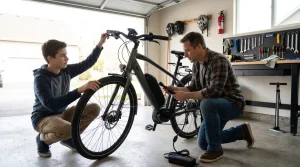 Maintain the E-Bike and Its Battery Properly
Mechanical maintenance is part of crash prevention, while electrical safety is essential for preventing battery-related incidents. Parents should make sure teenagers understand both.
A bicycle may look fine at a glance while still having worn brake pads, damaged tires, loose components, or a battery that requires attention.
Perform a Pre-Ride Inspection
Before riding, teenagers should inspect the tires for damage and check that they are inflated according to the manufacturer’s recommendations. They should test both brakes, confirm that the handlebars and seat are secure, and look for loose or damaged components.
Check that the wheels rotate properly, the chain or drivetrain appears to be functioning correctly, and the lights work when needed. Any unusual noise, vibration, error message, or change in braking should be investigated before the bicycle is used again.
Parents should arrange regular professional servicing according to the manufacturer’s maintenance schedule. More frequent inspections may be necessary if the e-bike is used daily, ridden on rough surfaces, or exposed to rain and dirt.
Charge the Battery Safely
E-bike batteries contain lithium-ion cells that can present a fire hazard if they are defective, damaged, improperly charged, or used with incompatible equipment.
Use only the charger supplied with the bicycle or one specifically approved by the manufacturer for that exact model. A charger that physically fits the connection is not necessarily electrically compatible.
The CPSC advises consumers to remain present while charging micromobility devices, avoid charging them while sleeping or away from home, and follow the manufacturer’s instructions. Its battery charging safety guidance explains why unsuitable universal chargers can create serious hazards.
Charge the battery in a suitable location away from exits and combustible materials, following the manufacturer’s instructions and local fire-safety guidance. Do not allow teenagers to charge the bicycle overnight unattended or leave it charging after the recommended charging period.
Recognize Battery Warning Signs
A battery that becomes unusually hot, swells, leaks, produces a strange odor, makes unusual noises, or emits smoke should be treated as a serious warning. A battery or bicycle that has suffered significant impact damage also requires careful assessment.
Stop using the affected equipment and follow the manufacturer’s safety instructions. If a battery is smoking, hissing, or burning, keep people away, leave the area, and call 911 from a safe location. Do not attempt to carry a burning battery through the house or handle a hazardous battery without appropriate guidance.
Parents should check product recalls and safety notices periodically, particularly when purchasing a used e-bike. If a model or battery is subject to a safety warning, follow the official instructions rather than assuming that the problem does not affect your particular unit.
Never allow teenagers to modify battery wiring, install incompatible batteries, bypass safety systems, or use damaged chargers.
Understand U.S. E-Bike Laws and Local Restrictions
E-bike rules are not identical throughout the United States. State laws may establish minimum ages, helmet requirements, equipment standards, and rules governing where different classes of e-bikes can operate. Municipalities and park authorities may impose additional restrictions.
Parents should research the laws that apply to their teenager before allowing independent riding.
Check Minimum-Age and Helmet Requirements
Some states impose age restrictions on certain e-bike classes or require helmets for younger riders. Other jurisdictions may have different requirements depending on the bicycle’s classification and where it is operated.
Do not rely solely on information printed on a seller’s website or on a general online article. Review current state transportation or motor vehicle agency guidance, as well as relevant city and county rules.
Even when a helmet is not legally required for a teenager in a particular situation, wearing one remains an important safety precaution.
Confirm Where the Bicycle May Be Used
Rules governing sidewalks, protected bike lanes, shared-use paths, parks, and trails can vary. A Class 3 e-bike may be restricted from certain facilities even where a Class 1 model is permitted.
Check local signs and regulations before planning a route. Parents should also understand whether local rules require specific lights, reflectors, or other equipment.
If a teenager rides across municipal boundaries, restrictions may change along the route. This is especially important in metropolitan areas where neighboring cities may have different regulations.
Review the Bicycle’s Legal Classification
A product described as an e-bike by a seller may not qualify as a conventional electric bicycle under the relevant state definition if it exceeds applicable motor-power or speed limits.
High-powered models, modified bicycles, and certain throttle-equipped products may be regulated differently. Do not assume that a bicycle is legal for public-road use simply because it can be purchased online.
When the classification is unclear, ask the relevant state agency or local law enforcement authority for guidance before allowing the teenager to ride it on public roads.
Know What to Do After an E-Bike Crash
Even careful riders can experience a collision. Knowing how to respond can help parents protect their teenager, communicate with emergency responders, and document what happened.
Recognize When Medical Attention Is Needed
A crash can cause injuries that are not immediately obvious. Head injuries, fractures, internal injuries, and soft-tissue damage may require prompt medical assessment even when the teenager initially says they feel fine.
Call 911 for serious injuries, loss of consciousness, confusion, seizures, difficulty breathing, heavy bleeding, severe pain, suspected neck or spinal injuries, or any other life-threatening concern. Avoid moving a seriously injured rider unless remaining in place presents an immediate danger.
If a teenager strikes their head, parents should take the possibility of a concussion seriously. Warning signs can include headache, dizziness, nausea, confusion, memory problems, sensitivity to light, or unusual behavior. Symptoms may appear after the initial impact.
Seek prompt medical advice after a suspected concussion. Do not allow the teenager to resume riding, playing sports, or other risky activities until a qualified healthcare professional has advised that it is safe to do so.
A helmet can reduce certain risks but cannot eliminate the possibility of a head injury. Parents should never use the absence of visible damage to a helmet as proof that the rider is uninjured.
Document the Incident
Once immediate safety and medical needs have been addressed, record the circumstances of the crash if it is safe and appropriate to do so.
Useful information may include the location, date, time, weather, road conditions, and a description of what happened. Photographs of the scene, damaged equipment, and relevant road features may help preserve information. If a motor vehicle was involved, collect the driver’s contact and insurance information when appropriate and safe.
For a serious collision, follow local reporting requirements and contact law enforcement when required. Avoid arguing with other parties at the scene or making assumptions about legal responsibility before the circumstances are understood.
Parents should also inspect the e-bike carefully before considering whether it can be used again. A damaged wheel, brake, frame, or battery may not be safe even if the bicycle appears repairable.
Talk About the Crash Without Creating Fear
After an incident, a teenager may feel embarrassed, anxious, or reluctant to discuss what happened. Parents should begin with the child’s safety and wellbeing rather than immediately assigning blame.
Ask what the teenager remembers, whether they noticed a hazard, and what might help them respond differently next time. If a mechanical failure or unsafe road design contributed to the crash, address those issues rather than focusing exclusively on the rider’s behavior.
A calm conversation can help teenagers learn from an incident without becoming so fearful that they hide future problems. The goal is to improve safety and encourage honest communication.
How Parents Can Build Long-Term Safe Riding Habits
One safety lecture is rarely enough to change behavior permanently. Teenagers benefit from repeated practice, clear expectations, and opportunities to demonstrate that they can make responsible decisions.
Schedule Regular Safety Conversations
Discuss riding habits periodically, not only after something goes wrong. Ask whether the teenager has encountered dangerous drivers, confusing intersections, aggressive riders, or changes in their regular route.
These conversations can reveal problems that parents might otherwise miss. For example, a teenager may be taking a shortcut through a busy parking lot because friends use that route, or they may feel pressured to ride faster to keep up with a group.
Treat these disclosures as opportunities to solve problems together. Help the teenager identify a safer alternative and explain how to handle similar situations in the future.
Practice Skills in a Controlled Environment
Supervised practice should include starting and stopping, controlled braking, low-speed maneuvering, shoulder checks, signaling, and safe turning. Teenagers should also practice scanning for hazards without losing control of the bicycle.
Begin in a quiet area away from moving traffic. As the rider becomes more competent, introduce more realistic situations gradually.
Parents should not move to complex road conditions merely because the teenager has become comfortable riding quickly. Confidence is useful only when it is supported by sound judgment and reliable control.
Encourage Responsible Independence
The long-term objective is to help teenagers manage their own safety without needing constant reminders. This requires giving them opportunities to make decisions while maintaining reasonable boundaries.
Ask your teenager to explain why they selected a particular route, how they would respond to a blocked bike lane, or what they would do if the brakes began making an unusual noise. Their answers can reveal whether they understand the principles behind your family’s rules.
Recognize thoughtful decisions, even when they involve inconvenience. Choosing a longer route, delaying a trip because of poor visibility, or calling for a ride when a bicycle develops a mechanical problem are signs of maturity.
A Practical Parent’s Checklist for Teen E-Bike Safety
Before allowing a teenager to ride independently, review these essential safety practices with them.
-
The e-bike is appropriate for the teenager’s size, experience, and legal eligibility.
-
The rider wears a properly fitted bicycle helmet on every trip.
-
Both brakes, tires, wheels, handlebars, and lights have been checked.
-
The teenager understands the bicycle’s acceleration and braking behavior.
-
State and local e-bike laws have been checked.
-
The approved route and any restricted areas have been discussed.
-
The rider knows how to navigate intersections, driveways, and parked vehicles safely.
-
Phones are put away while the bicycle is moving.
-
Dangerous stunts, racing, unauthorized passengers, and riding under the influence are prohibited.
-
The teenager knows how to contact a parent and respond to a mechanical problem.
-
Battery charging and maintenance rules are understood.
-
The family has agreed on riding times, check-ins, and consequences for unsafe behavior.
This checklist is a starting point rather than a guarantee against crashes. Parents should adapt it to the teenager’s experience, the local environment, and the type of e-bike being used.
Conclusion: Make Safety Part of Every Teen E-Bike Ride
Electric bicycles can provide teenagers with valuable independence, recreation, and convenient transportation. However, those benefits depend on choosing suitable equipment, understanding traffic risks, and developing responsible habits before riding independently.
Parents can make a meaningful difference by selecting an appropriate e-bike, insisting on helmet use, teaching defensive riding skills, planning safer routes, and addressing dangerous behaviors such as speeding, stunt riding, and phone distraction. Regular mechanical inspections and safe battery charging are equally important parts of responsible ownership.
Just as importantly, parents should keep communication open. Teenagers need to feel comfortable reporting a near miss, asking for help, or admitting that a route or situation made them uncomfortable. These conversations allow families to correct problems before they lead to more serious consequences.
Teen e-bike safety is not about eliminating every possible risk or preventing teenagers from becoming independent. It is about helping them understand their responsibilities, recognize hazards, and make safer decisions even when parents are not present.
When families combine practical training, appropriate equipment, consistent rules, and ongoing communication, they give young riders a stronger foundation for safer cycling throughout their teenage years and beyond.