
Whether you are an early-morning road cyclist, a night-shift urban commuter, or an evening e-bike rider, proper lighting is your most critical active safety system. While a quality helmet protects your head during a collision, active bicycle lighting works proactively to prevent accidents from happening in the first place.
However, browsing the bike light market can be overwhelming. Manufacturers throw around confusing terms like lumens, lux, wide flood beams, daytime pulse modes, and IPX battery ratings. Choosing the wrong light can leave you blind on dark roads or invisible to oncoming motorists. This ultimate buyer’s guide breaks down the science of bicycle lights to help you select the perfect setup for your riding style.
1. Understanding Lumens vs. Lux: How Bright Do You Really Need?
The most prominent specification listed on any bike light box is the lumen rating. Lumens measure the total amount of light emitted by the bulb in all directions. While higher lumen counts generally mean a brighter light, lumens alone do not tell the whole story.
Lumens vs. Lux Explained
- Lumens (Total Output): The total light energy produced by the LED source.
- Lux (Light Intensity at a Distance): Measures how much of that light actually hits a specific surface area at a given distance. One lux equals one lumen per square meter.
A 1,000-lumen light with a poor lens spread may scatter light everywhere, blinding oncoming traffic while failing to illuminate pothole hazards on the road directly ahead. Conversely, a well-engineered 500-lumen light with precision optics will focus brightness exactly where your eyes need it.
Recommended Lumen Thresholds by Riding Environment
- Well-Lit City Streets (200 – 400 Lumens): Your main goal is to be seen by drivers rather than lighting up a pitch-black path. Focus on flash modes and side visibility.
- Suburban Roads & Unlit Bike Paths (400 – 800 Lumens): Required to clearly spot road debris, potholes, and pedestrians at medium speeds (12–18 MPH).
- Dark Rural Roads & High-Speed E-Biking (800 – 1,500+ Lumens): High output is mandatory to throw light far enough down the road to allow adequate braking reaction time at speeds of 20–28 MPH.
2. Beam Patterns: Flood vs. Spot vs. Shaped StVZO Optics
How a light distributes its output is just as important as how bright it shines. Bike lights generally feature one of three primary beam patterns:
1. Spot Beams (Focused Distance)
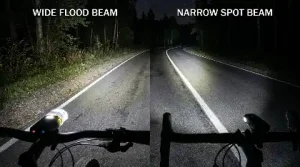
Spot optics concentrate light into a narrow, intense cone. This projects illumination far down the road, which is ideal for high-speed riding on unlit country lanes. However, spot beams offer poor side visibility and fail to illuminate low hazards near your front wheel.
2. Flood Beams (Wide Peripheral Coverage)
Flood lenses spread light broadly across the roadway, illuminating street signs, shoulders, and peripheral hazards like emerging wildlife or opening car doors. They are excellent for slow-to-moderate urban speeds but lack long-distance projection.
3. Cut-Off / Shaped Beams (StVZO Standard)
Originating under German road traffic regulations (StVZO), shaped-beam lights feature a hard horizontal cut-off line at the top of the light beam. Similar to automotive low beams, they direct all light downward onto the road surface without shining directly into the eyes of oncoming motorists, pedestrians, or fellow cyclists.
3. The Critical Role of Daytime Running Lights (DRLs)
A common misconception among cyclists is that lights are only necessary after sunset. According to crash safety research, over 80% of bicycle accidents occur during daylight hours, with vehicle-cyclist side and rear-end collisions being among the most severe.
What Makes a True Daytime Running Light?
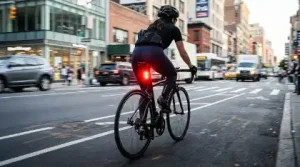
Simply turning a low-powered headlight on during the day is insufficient; direct sunlight washes out standard steady beams. Dedicated Daytime Running Lights (DRLs) utilize three specific design traits:
- High Peak Intensity: Bursting high lumen outputs designed specifically to cut through ambient midday sunlight.
- Disruptive Flash Profiles: Utilizing unpredictable, non-repetitive pulse patterns that trigger quick visual processing in driving motorists.
- Broad Angle Optics: Engineered with side-illumination ports so you remain visible at angled city intersections.
Studies show that running dedicated daytime flashers front and rear reduces collision risk by up to 33% compared to riding without lights.
4. Rear Tail Lights: Flash Modes, Smart Sensors, and Radars
While headlights guide your path, rear lights keep you safe from traffic approaching from behind. Modern rear tail lights have evolved far beyond basic red blinking LEDs:
- Minimum Output: Look for at least 50–100 lumens for rear day-flashing modes, and 20–30 lumens for steady night riding.
- Smart Accelerometer Braking: Premium tail lights feature built-in accelerometers that detect sudden deceleration, automatically switching to a solid, bright brake light mode to alert trailing drivers.
- Rear-Facing Radar Integration: Advanced units (such as Garmin Varia systems) pair rear lights with millimeter-wave radar to detect cars approaching from up to 150 meters away, displaying real-time vehicle alerts directly on your handlebar computer or phone screen.
5. Battery Life, Mounting, and Weatherproofing
Before making your final purchase, evaluate these essential practical features:
Battery Runtime & Recharging
Always check runtime charts at the specific lumen level you plan to use—not just the advertised maximum runtime, which usually applies to low eco-modes. Look for USB-C fast-charging units, and consider lights with built-in battery percentage indicators.
IPX Water Resistance Ratings
Cycling lights must withstand heavy rain and road spray. Aim for a minimum rating of IPX4 (splash-resistant) for casual riding, or IPX6/IPX7 (waterproof against heavy rain and immersion) if you commute year-round in all weather conditions.
Secure Mount Systems
Avoid cheap rubber strap mounts for heavy front headlights; they bounce out of position on rough asphalt. Opt for rigid, glass-filled nylon handlebar brackets with quick-release levers for easy removal when parking in public.
Summary
A great bike light setup combines a shaped, high-lux headlight that illuminates your path without blinding others, a high-visibility daytime running light setup, and a smart, wide-angle rear flasher. Investing in quality illumination ensures you stay visible, confident, and safe on every ride—day or night.
External References: